
Healing Long Covid
and everything else. Reclaiming is a long game.

If you’re new here, welcome to On the Commons!
Some places to roam:
How, and and why, does anyone own the earth?
Walkability when a problem is systemic, or: you can’t solve for traffic.
✔️ Join over 7,000 On the Commons readers. Upgrade here.
One of my oldest and closest friends, a roommate from my undergraduate days, is a public school art teacher in Minneapolis, Minnesota. During the Twin Cities’ current federal government-driven violent crisis, she is part of a team arranging rides for kids, raising money for rent assistance, etc. She has given me permission to share her Venmo if you are looking for a way to contribute: https://account.venmo.com/u/AlisonShipmanThompson
Recently, I stopped at the county landfill to tip my recycling into their dedicated bins. The region I live in doesn’t have much recycling. Cardboard, paper, and aluminum cans. No plastics. We used to have glass recycling but the person who owned that equipment got ill, and nobody else has been able to find enough market for the recycled products from glass. I pay for a weekly compost service, which makes me feel a little better, especially when I order compost from them in the spring and bury seed potatoes in it.
Going to the landfill is both gut-wrenching and surreal. When I was a teenager, the dump was a pit in the ground. Now it’s an ever-growing small mountain. A few years ago, the county I live in purchased 90 more acres to expand the landfill, a reality that’s a bit of a brain-twister: arable, beautiful, life-giving, and expensive land is needed so that we can dump our waste, probably most of which is the result of entirely unnecessary consumption, including my own. All I can say is that most of that waste stays local. There is no out of sight out of mind; you can see the landfill just off the main highway.
The recycling bins are near the appliance dump: a growing hill of dishwashers, washing machines, stoves, and refrigerators backed by stands of spruces and lodgepole pines.
I often see Bald Eagles at the dump. While the sight is sad—it’s obviously the trash that draws them there—a Bald Eagle never fails to be majestic. The soul bows, as I wrote once, at the sight of that grand white head, or the speckled one of a juvenile, those enormous wings almost unmoving through the air, staying aloft with only an occasional downdraft.
This time, I glanced around for Ravens and instead saw a Bald Eagle fly to the top of a tree. Then I looked more closely, my car still running with Nine Inch Nails on the CD player, and couldn’t help saying out loud to myself, whoa.
I counted fifteen Bald Eagles roosting around the appliance area of the landfill, occasionally lifting off to soar over to another tree. Fifteen Bald Eagles.
When I was a kid, I could not have imagined such a sight, at the dump or anywhere else. From consuming DDT in fish and other dangers—like the lead from hunting bullets that linger in animals the Eagles eat—Bald Eagles were in crisis. It was something we learned about in Montana schools, or at least the ones I attended. A passing mention: they were an endangered species but the adults had it covered, we were assured. They were fixing it.
I’m going to turn 50 this year, and for about the last decade those long-ago lessons have been one of the most hopeful things I carry with me, somewhat unexpectedly. Bald Eagles were delisted from being endangered in 2007, and though we obviously live in a world run by a domination ethos, one that does not value life and in which there are very few adults “fixing” anything, a dominant culture whose soul does not bow to Eagle overhead, whether in the wilderness or at the dump, I now see Bald Eagles quite often. As a child growing up in Montana I can barely remember seeing even one.
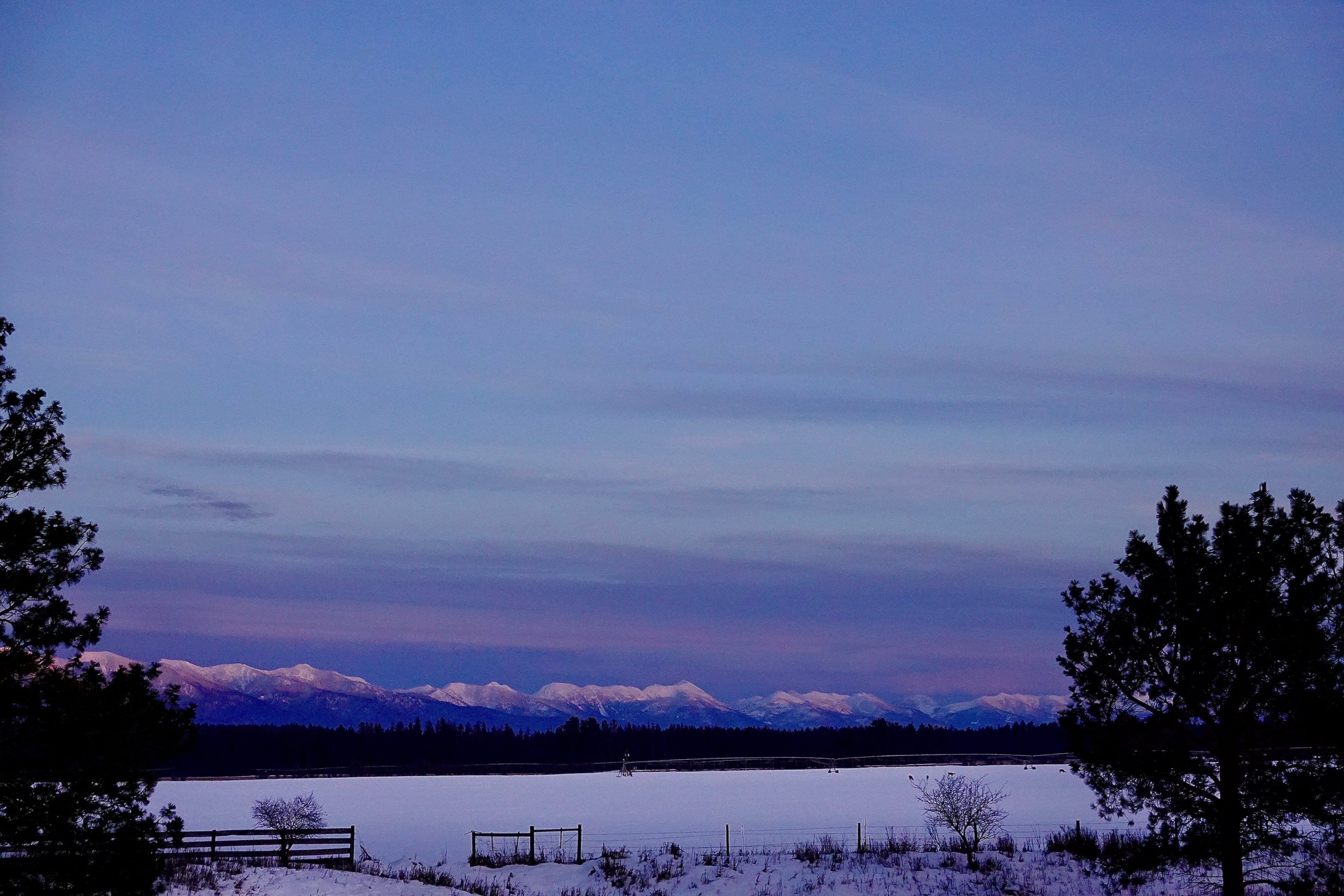
A week or two after counting fifteen of them at the dump, I was away for a weekend with some of my closest friends, near home but out of town, with long views to the mountain ranges and over farm fields. Two of my friends kept spotting Bald Eagles flying back and forth over the fields, and resting in the trees across the road. I took a few very bad photos of said Eagles. We cooked food and smelled the snow and two friends taught me and another to play pinochle.
All my friends but me ventured out for forest walks and cross-country skiing. Much as my physical and mental self ached to be moving through the woods, I am only just beginning to feel a bit of strength and stamina return after at least two years of being flattened by Long Covid, and recovering from a hip surgery in October.
The reality of Long Covid has been maddening. I’m tired all the time, struggle with brain fog, really feel like I shouldn’t be driving but where I live it’s almost unavoidable, and want nothing more than to lie for hours in the sun by a river. Any river.
Last summer I regretfully canceled my volunteer wilderness trail crew commitment and didn’t sign up for a single barbed wire fencing removal weekend. My entire being desperately needed wilderness, and barbed wire removal in particular is one of the world-repairing tasks I like doing most, but I knew I couldn’t handle the long miles of hiking into camp, much less the longer days of manual labor.
Long Covid has no real fixes from medicine yet. I am very fortunate to have a number of friends with extensive experience on both sides of medicine, both providers and patients. They have advice, and send me scientific studies and reports of treatment trials. I try different remedies. So far, what’s worked best has been excrutiatingly slow, gentle exercise, along with any long hours I can spend by myself lying on rocks near running water, doing nothing at all.
I hesitate to say that nature cures, even though I believe it does and research backs that up, but it feels like about the only thing that might work in the long run.
The slow, frustrating reality of trying to heal Long Covid—which I don’t even know is possible—reflects a little too closely the slow, frustrating nature of trying to heal the scars left by several millennia of domination cultures and subsequent intergenerational traumas. If we could just get a start, I keep thinking, the way I finally got a start on slow, frustrating exercise by grumbling my way to the community gym last month because the sewer backed up into my basement and I needed a place with a shower.
But all those forces of domination and commodification, they don’t want to give room for a start. They might lose profits, and they might lose power, and for people whose only sustenance, whose only meaning, comes from those two things, the thought of losing them probably feels like death.
The rest of us have to find our way to stopping them anyway. And in the meantime, as I try to remind both myself and readers here, there are people all over the planet getting a start on healing, on revitalization and life-giving practices, on reclaiming the commons despite forces that want nothing but more extraction, more oppression, more pain and poison and harm.
The only reason humanity has survived this long is that enough people have fundamentally refused to give up caring, no matter how slow or how frustrating its results might be in coming.
While hanging out on the couch of the house my friends and I were staying at, where Bald Eagles flew across much prettier landscape than that found at the dump, I thought about longstanding debates over what is deemed “natural.” About why wilderness was invented in the first place, and why protection of it is fought for: quite simply, because the dominant culture can’t seem to help destroying everything else.
I had an essay published recently in American Prairie Journal with the title “Where Land Repairs the Soul.” (My essay is on p. 38, or 40 on the Issuu platform; excellent reading throughout this issue!) Among the subjects of enclosures of the commons and the meaning of wilderness, the essay was really about belonging. About what it would take for every person in every place to feel, even for a few moments, what it might mean to belong to land. Not to own it, not even necessarily to use it. Simply to belong to it.
That sense of belonging comes easily to me out in the million-acre wildernesses around where I live, where I take photos to share here, photos that try to evoke some of the incredible sense of rest and being-aliveness those places give me.
But if I take enough time and give enough attention, I feel it, too, at the dump, watching a Bald Eagle soar and knowing right through the soles of my feet that under and even within the appliances and mountain of trash, everything is alive. I can never disentangle myself from interconnection with it all even if I wanted to.
And I don’t. I don’t want to. Learning to repair both the world and our individual selves might turn out to be one of the greatest gifts humanity has ever received, right below the gift of this miraculous planet herself. I wish the repair weren’t necessary, but it’s a process worth doing well. Who knows what this landfill will look like in a hundred years, or five hundred, or a thousand, what world the Bald Eagles’ descendants might know.
Your trash might be a Bald Eagle’s treasure, and in some strange way it’s mine, too.
Until March 31, 5% of On the Commons revenue will be given to the 2026 James Welch Native Lit Festival. Last quarter’s 5% went to Firekeeper Alliance. Receipts of revenue return can be found here.


I’m on the cusp of making another shift in my life— one that has required a lot of finding homes for a great number and a great variety of things so they don’t end up in landfills (at least not yet). Three thrift stores (and multiple trips to one of them), one Habitat for Humanity, two houseless shelters, a recycling center trip or two, a tucked-away pharmacy, a great many no thank yous, an auto repair shop that finally took pity on me, and more Facebook marketplace interactions than I care to remember later, I feel much lighter and in community.
And it’s given me a whole new perspective on just how difficult it can be to home things or dispose of them correctly.
My friend, I’m so sorry you’ve been feeling so poorly. May you find as much time as possible a top sunny rocks near flowing rivers.
I, too, am turning 50 this year. And I sort of love that we’ll reach this milestone together.
Another wonderful post and opportunity to connect.
We are currently staying at our timeshare near Port Townsend, WA. We have a lovely stretch of beach with some trees and a lagoon and a snag where the eagles usually nest. They aren't here at the moment but I hope they are back when we return later this summer.